Tribal
Investigating Disparities in Behavior and Care Between Alaska Native and White Victims of Sexual Violence: The Importance of Culturally Competent Nursing Care
Gender-Based Violence and the Latinx Community
See the YouTube Terms of Service and Google Privacy Policy
Findings from the Federal, State, and Tribal Response to Violence Against Women in Indian Country Studies
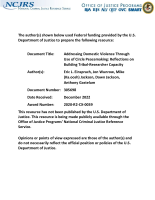
Addressing Domestic Violence Through Use of Circle Peacemaking: Reflections on Building Tribal-Researcher Capacity
Embracing Tribal Culture to Build Research Partnerships
The association of neoplasms and HIV infection in the correctional setting
The Effectiveness of Forensic Genetic Genealogy Techniques for Black, Indigenous, and Persons of Color
The Adaptation and Evaluation of the Fourth R Youth Dating Violence Curriculum for Indigenous Communities
Tribal Crime, Justice, and Safety, Part 2
Stacy Lee Reynolds and Christine (Tina) Crossland continue their discussion of tribal crime, justice, and safety, including how Native American persons experience crime victimization at higher rates than non-Native people and the jurisdictional complexities in responding to tribal crime, justice, and safety. Read the transcript.
Listen to the first half of Stacy and Tina’s discussion.
Reading and Resources from NIJ
Tribal-Researcher Capacity Building Grants
A hidden cost of convenience: Disparate impacts of a program to reduce burden on probation officers and participants
Tribal Crime, Justice, and Safety
Tribal Crime, Justice, and Safety, Part 1
Research indicates that Native American persons experience crime victimization at higher rates than non-Native people. Furthermore, the unique position of American Indian and Alaska Native tribes as both sovereign nations and domestic dependents of the U.S. creates jurisdictional complexities in responding to crime, justice, and safety. Senior social and behavioral scientist Christine (Tina) Crossland discusses NIJ’s research on these topics, especially on the prevention of violence towards American Indians and Alaska Natives. Communications Assistant Stacy Lee Reynolds hosts.
Assessing American Indian Suicide Risk: Can Screening be Culturally Sensitive?
Drug Use Impact on Native People in Minnesota
On Assessing the Scope of Missing Native Americans in Nebraska: Results From a State-Wide Study and Recommendations for Future Research
Exploring Help Seeking Patterns for Emerging Adult Victims Using the National Intimate Partner and Sexual Violence Survey
Improving identification of unknown American Indians and Hispanic/Latinx Americans
Implementing NAGPRA Connecting Medical Examiner and Coroner Offices to Tribal Partners
This project is designed to connect tribal partners to ME/C offices to facilitate successful disposition protocols for non-forensically significant Native American remains that are compliant with the Native American Graves Protection and Repatriation Act of 1990 (NAGPRA).
See the YouTube Terms of Service and Google Privacy Policy
Implementing NAGPRA: Connecting Medical Examiner and Coroner Offices to Tribal Partners