Criminal histories
Productivity and Resource Allocation in Prosecution and Public Defender Agencies
Duration of Adult Criminal Careers - Final Report
Individual, Firearm, and Purchasing Characteristics Associated with Risk of Firearm-related Violent Crime Arrest: a Nested Case-control Study
Firearm Purchase Behavior and Subsequent Adverse Events
Crime and Victimization on the US-Mexico Border: A Comparison of Legal Residents, Illegal Residents and Native-Born Citizens
THEORETICAL PERSPECTIVES ON ALIENATION IN THE PRISON SOCIETY - AN EMPIRICAL TEST
Assessing the Relationship Between Treatment Quality, Matching and Dosage and Juvenile Justice Outcomes Among Youth With Co-Occurring Substance Abuse and Mental Health Disorders
How to Free a Butterfly: The Impact of Fair Chance Housing Ordinances on the Housing Outcome of System-Impacted Black Individuals
AI R&D to Support Community Supervision: Integrated Dynamic Risk Assessment for Community Supervision (IDRACS), Final Report
The Empirics of Immigration and Homicide: Evidence from California and Texas
Unauthorized Immigration, Crime, and Recidivism: Evidence from Texas
Will History Repeat Itself? Growth Mixture Modeling of Suspected Serial Sexual Offending Using Forensic DNA Evidence
Criminal Record Questions in the Era of "Ban the Box"
Redemption Research and Offender Employability
A multisite examination of women veterans in veterans treatment courts: a gendered comparison of demography, criminal history, program requirements, and substance use and mental health issues
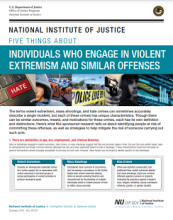
Five Things About Individuals Who Engage in Violent Extremism and Similar Offenses
Cohort bias in predictive risk assessments of future criminal justice system involvement
Cohort Profile: Project on Human Development in Chicago Neighborhoods and Its Additions (PHDCN+)
Life-course and Intergenerational Effects of Crime and Criminal Justice Involvement: Identifying Risks and the Search for Resilience
Inclusive Research: Engaging People Closest to the Issue Makes for Better Science & Greater Impact; 2023 NIJ Research Conference Plenary
This panel will discuss what inclusive research is, how to conduct it, and what issues and challenges exist about engaging in it. “Inclusive research” has its history as a participatory research method designed to ensure people closest to the issue or problem under study are authentically engaged in the research process rather than simply being “research subjects.” While community-based participatory research has begun to take on greater prominence in the criminal justice realm, such efforts are largely confined to qualitative research inquiries.
See the YouTube Terms of Service and Google Privacy Policy