Recidivism
Does Reassessment Improve Prediction? A Prospective Study of the Sexual Offender Treatment Intervention and Progress Scale (SOTIPS)
Recidivism Reconsidered: Preserving the Community Justice Mission of Community Corrections
You Get What You Measure: New Performance Indicators Needed to Gauge Progress of Criminal Justice Reform
The Effect of Victim Impact Panels on DUI Rearrest Rates: A Five-Year Follow-Up
Making the Most of Second Chances: An Evaluation of Minnesota's High-Risk Revocation Reduction Reentry Programs
Effectiveness of a Mental Health Court in Reducing Criminal Recidivism and Violence.
Controlling Violent Offenders Released to the Community: An Evaluation of the Boston Reentry Initiative
The Impact of Prison-Based Treatment on Sex Offender Recidivism
Can Faith-Based Correctional Programs Work? An Outcome Evaluation of the InnerChange Freedom Initiative in Minnesota
Treating Drug-Abusing Women Prisoners: An Outcome Evaluation of the Forever Free Program
Reentering Women: The Impact of Social Ties on Long-Term Recidivism
NIJ FY22 Research and Evaluation on Desistance from Crime
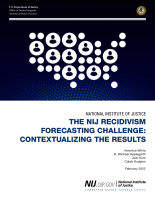
The NIJ Recidivism Forecasting Challenge: Contextualizing the Results
Booker and Beyond Analyzing Sentencing Reform and Exploring New Research Directions
This webinar features a discussion of previously published research on the U.S. Supreme Court’s 2005 Booker decision - which effectively transformed the United States Sentencing Guidelines from a mandatory, to an advisory, system. The presentation will address selected research findings from the last 15 years. Individual participants will briefly review their previous research findings with particular attention paid to the analytic methods used.
See the YouTube Terms of Service and Google Privacy Policy
FY 2020 Report to the Committees on Appropriations - Formerly Incarcerated Women and Reentry: Trends, Challenges, and Recommendations for Research and Policy
Desistance From Crime: Implications for Research, Policy, and Practice
Most scholars would agree that desistance from crime – the process of ceasing engagement in criminal activities – is normative. However, there is variability in the literature regarding the definition and measurement of desistance, the signals of desistance, the age at which desistance begins, and the underlying mechanisms that lead to desistance. Even with considerable advances in the theoretical understanding of desistance from crime, there remain critical gaps between research and the application of that research to practice.
See the YouTube Terms of Service and Google Privacy Policy
Does in-prison physical and mental health impact recidivism?
NIJ’s Courts Research: Examining Alternatives to Incarceration for Veterans and Other Policy Innovation
NIJ’s evaluation of veterans treatment courts is a recent example of applied research under its Courts Research Portfolio, which examines pretrial, prosecution, and sentencing policies; problem-solving courts, and other alternatives to incarceration.