Medical examiners
Tribal Crime, Justice, and Safety, Part 1
Research indicates that Native American persons experience crime victimization at higher rates than non-Native people. Furthermore, the unique position of American Indian and Alaska Native tribes as both sovereign nations and domestic dependents of the U.S. creates jurisdictional complexities in responding to crime, justice, and safety. Senior social and behavioral scientist Christine (Tina) Crossland discusses NIJ’s research on these topics, especially on the prevention of violence towards American Indians and Alaska Natives. Communications Assistant Stacy Lee Reynolds hosts.
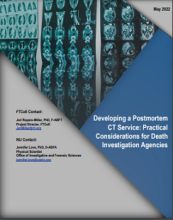
Developing a Postmortem CT Service: Practical Considerations for Death Investigation
The Evidence We Leave Behind, Part 2
Associations Detected between Measures of Neighborhood Environmental Conditions and Human Microbiome Diversity
Strengthening the Medical Examiner–Coroner System Through NIJ-funded Programs: 2018 Medicolegal Death Investigation Stakeholders’ Meeting
Medical Examiner and Coroner Outsourcing Study: A Qualitative Study and Cost-Benefit Analysis
Things Are Not What They Seem: A Collection of Interesting Case Studies from the Medical Examiner Scene Queens
The roles of medical examiners in the COVID-19 era: a comparison between the United States and Italy
A Forward-Thinking Approach to Addressing the New Synthetic Opioid 2-Benzylbenzimidazole Nitazene Analogs by Liquid Chromatography-Tandem Quadrupole Mass Spectrometry (LC-QQQ-MS)
Metonitazene in the United States-Forensic toxicology assessment of a potent new synthetic opioid using liquid chromatography mass spectrometry
The next generation of synthetic cannabinoids: Detection, activity, and potential toxicity of pent-4en and but-3en analogues including MDMB-4en-PINACA
Quantitation of Fentanyl and Metabolites from Blow Fly Tissue and Development Effects of Fentanyl on Lucilia Sericata
Evaluation of the Routine Use of CT Scanning to Supplant or Supplement Autopsy in a High-Volume Medical Examiner's Office
Strengthening the Medicolegal-Death-Investigation System: Improving Data Systems
Reliability and Validity of Radiographic Comparisons for Positive Identification
Improving Age-at-Death Estimates from Human Skeletal Remains Through Spatial Analysis of Intracortical Remodeling Using Geographic Information Systems Software
Implementing NAGPRA Connecting Medical Examiner and Coroner Offices to Tribal Partners
This project is designed to connect tribal partners to ME/C offices to facilitate successful disposition protocols for non-forensically significant Native American remains that are compliant with the Native American Graves Protection and Repatriation Act of 1990 (NAGPRA).
See the YouTube Terms of Service and Google Privacy Policy
Implementing NAGPRA: Connecting Medical Examiner and Coroner Offices to Tribal Partners