Crime laboratories
A Multi-year Characterization of Confiscated Vaping Products from Virginia School Youth
Expert Algorithm to Identify Seized Drugs from Tandem Mass Spectra
The Impact of Processing and Sampling Procedures on the Integrity of Forensically Relevant Biomolecules in Bones
On the reliability of the forensic examination of electrical tapes and the influence of alteration sources encountered in casework
Differentiation of Hemp and Marijuana Through Ion Complexation with Copper Phosphine Complexes
Research and Development for the Creation of Validated Protocols for the Forensic Detection and Quantification of Psilocybin and Psilocin in Complex Edible Matrices
Development of new cocaine hair testing guidelines: investigation of decontamination protocols, damage/adulteration evaluation, and cosmetic treatment impact
A Rapid and Accurate Liquid Chromatographic Method for Hemp Compliance Testing
Development of a Liquid Chromatographic Method with a Different Selectivity for the Quantification of Eighteen Phytocannabinoids in Hemp
Identification of ADB-5'Br-BINACA in Plant Material and Analytical Characterization Using GC-MS, LC-QTOF-MS, NMR and ATR-FTIR
Near-infrared Excitation Raman Spectroscopy of Colored Fabric Contaminated with Body Fluids
Differentiation of Regioisomeric N-Substituted Meta-Chlorophenylpiperazine Derivatives
DNA mixture interpretation of SNP sequencing data for investigative genetic genealogy
A Combined Molecular Analysis of Pollen Utilizing Lipid Profiling & DNA Barcoding for Plant Species Identification: A Forensic Application
Advancing New Psychoactive Substance Detection by Performance Comparison of High-Resolution Mass Spectrometry Techniques
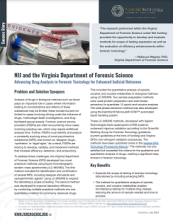
Success Story: NIJ and The Virginia Department of Forensic Science Advancing Drug Analysis in Forensic Toxicology for Enhanced Judicial Outcomes
New Screening Method to Detect Drugs and Poisons Postmortem
Ethical Data Sharing in Forensic Research
Screening for Forensically Relevant Drugs Using Data-Independent High-Resolution Mass Spectrometry
Mass Spectral and Chemometric Analysis for the Detection and Identification of Forensically Relevant Materials
Forensic Analysis of Salvia Divinorum Using Multivariate Statistical Procedures. Part II: Association of Adulterated Samples to S. Divinorum
Evaluating the Robustness and Ruggedness of a Statistical Model for Comparison of Mass Spectral Data for Seized Drug Identification
Expert Algorithm for Substance Identification Using Mass Spectrometry: Application to the Identification of Cocaine on Different Instruments Using Binary Classification Models
Connecting Researchers and Forensic Laboratories
Collaboration between researchers and practitioners can improve the relevance and impact of forensic science research. NIJ encourages researchers to seek and partner with forensic science laboratories and other practitioners. Likewise, we encourage practitioners to work with research partners to help guide the relevance of NIJ funded research. These collaborations...