Domestic violence
Overview of UAA Justice Center Violence against Women Research
Campus Sexual Assault Responses (CSAR): Informing Trauma-Informed Policies, Protocols, and Training
Sexual violence is a significant criminal justice problem with long-term effects for its victims. In particular, sexual assault on or related to college campuses across the United States presents a growing public health and economic burden, starting with significant impacts on academic outcomes.
See the YouTube Terms of Service and Google Privacy Policy
Gender-Based Violence and the Latinx Community
See the YouTube Terms of Service and Google Privacy Policy
Economic Justice for Survivors of Intimate Partner Violence
See the YouTube Terms of Service and Google Privacy Policy
Defining and Studying Elder Abuse Polyvictimization
NIJ Social Science Analyst Yunsoo Park shares her knowledge about elder abuse, a widespread issue in the U.S. and around the world, particularly polyvictimization — the experience of a range of different types of abuse and maltreatment. As much as 11% of community-residing older adults experienced some form of abuse or mistreatment in the past year. Yunsoo discusses risk factors, difficulties in defining and studying elder abuse polyvictimization, and strategies for intervention and prevention. Stacy Lee Reynolds, a Communications Assistant with NIJ, hosts.
Predicting Teen Dating Violence Perpetration
Findings from the Federal, State, and Tribal Response to Violence Against Women in Indian Country Studies
Addressing Domestic Violence Through Use of Circle Peacemaking: Reflections on Building Tribal-Researcher Capacity
Understanding, Preventing, and Responding to Human Trafficking
Shedding Light on Assault
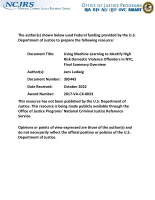
Using Machine Learning to Identify High Risk Domestic Violence Offenders in NYC, Final Summary Overview
Social Media and Domestic Radicalization
Social media has become a potent tool for spreading extremist beliefs and promoting violent extremism. NIJ Social Science analyst Aisha Javed Qureshi joins writer-editor Paul Haskins for a conversation about how scientific research is helping law enforcement and other agencies understand and address this growing concern.
Understanding and Responding to Domestic Extremism Financing
The Impact of Brain Injury Services in Domestic Violence Cases: A Randomized Control Trial
Safe Transitions for Teens: Assessing the Impact of Intimate Partner Transitional Housing on Adolescent Residents
Dependence in Adult Relationships: Latent Classes of Relational Dependence and Associated Outcomes in Women Exposed to Intimate Partner Abuse
Tribal Crime, Justice, and Safety, Part 1
Research indicates that Native American persons experience crime victimization at higher rates than non-Native people. Furthermore, the unique position of American Indian and Alaska Native tribes as both sovereign nations and domestic dependents of the U.S. creates jurisdictional complexities in responding to crime, justice, and safety. Senior social and behavioral scientist Christine (Tina) Crossland discusses NIJ’s research on these topics, especially on the prevention of violence towards American Indians and Alaska Natives. Communications Assistant Stacy Lee Reynolds hosts.