Medicolegal death investigations
The Effects of Cranial Orientation on Forensic Frontal Sinus Identification as Assessed by Outline Analyses
Rheology of brain tissue and hydrogels: A novel hyperelastic and viscoelastic model for forensic applications
Penetrating gunshots to the head after close-range shooting: Dynamics of waves and the effect of brain tissue rheology
Body mass classification from skeletal elements using landmark-free morphological atlas estimation with diffeomorphic shape mapping
Testing metrics for password creation policies by attacking large sets of revealed passwords
Incorporating accountability into internet email
Password Cracking Using Probabilistic Context-Free Grammars
A genetic study of the development of Cochliomyia macellaria (Fabricius) (Diptera: Calliphoridae): Ecological, evolutionary, and forensic importance of the secondary screwworm
2024 NIJ Forensic Science Research and Development Symposium
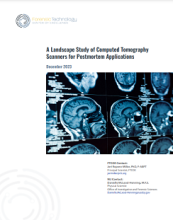
A Landscape Study of Computed Tomography Scanners for Postmortem Applications
Ontogenetic Patterns in Frontal Sinus Shape: A Longitudinal Study Using Elliptical Fourier Analysis
Perinatal Disorders and Small Birthweight Are Significantly Associated With Small Vertebral Neural Canal Size in a Contemporary Pediatric Autopsy Sample
Microbial Ecology of Vertebrate Decomposition in Terrestrial Ecosystems
Evaluation of Missing Data Imputation Methods for Human Osteometric Measurements
Distinguishing Infested Flour from Uninfested Flour through Chemometric Processing of DART-HRMS Data─Revealing the Presence of Tribolium castaneum, the Red Flour Beetle
A case study for local data surveillance in opioid overdose fatalities in Cuyahoga County, OH 2016-2020
Simplified COI barcoding of blow, flesh, and scuttle flies encountered in medicolegal investigations
Error and bias in race and ethnicity descriptions in medical examiner records in New Mexico: Consequences for understanding mortality among Hispanic/Latinos
OsteoID: A New Forensic Tool to Help Identify the Species of Skeletal Remains
NIJ-supported researchers developed a free web tool to help forensic investigators and others interested in bone identification.
Improving Methods Using Machine Learning and Databases in Forensic Anthropology
NIJ Awards $16M to Support Forensic Science Research
On September 26, 2023, NIJ announced $16 million in new funding to support 33 projects under the FY23 Research and Development in Forensic Science for Criminal Justice Purposes solicitation. Through this program, NIJ continues to advance the speed, accuracy, and reliability of forensic analysis, which ultimately bolsters the administration of justice.
Funding Highlights for Fiscal Year 2023
Since 2009, NIJ has invested nearly $300 million...