Female
Harnessing the Power of Technology in Institutional Corrections
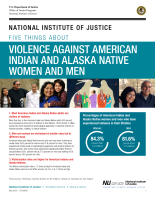
Violence Against American Indian and Alaska Native Women and Men (Video)
Solutions in Corrections: Using Evidence-based Knowledge
Professor Ed Latessa describes how his team and he assessed more than 550 programs and saw the best and the worst. Professor Latessa shared his lessons learned and examples of states that are trying to use evidence-based knowledge to improve correctional programs.
See the YouTube Terms of Service and Google Privacy Policy
Civil Protection Order Enforcement
T.K. Logan discusses her study that looked at the impact of civil protective orders for domestic violence victims in five Kentucky jurisdictions. Civil protective orders, sometimes known as restraining orders, may cover various situations, such as ordering an assailant to avoid a victim's home and workplace or forbidding any contact with the victim, including by mail or telephone.
See the YouTube Terms of Service and Google Privacy Policy
Nurse-Family Partnerships: From Trials to International Replication
David Olds, founder of the Nurse-Family Partnership Program, describes the programs long-term impact on mothers and babies who began participating in the program more than 19 years ago. The Nurse-Family Partnership maternal health program introduces vulnerable first-time parents to maternal and child health nurses. It allows nurses to deliver the support first-time moms need to have a healthy pregnancy, become knowledgeable and responsible parents, and provide their babies and later children and young adults with the best possible start in life.
See the YouTube Terms of Service and Google Privacy Policy
Mothers & Children Seeking Safety in the US: A Study of International Child Abduction Cases Involving Domestic Violence
Since the implementation of the Hague Convention on the Civil Aspects of International Child Abduction, thousands of abused women have faced complex litigation after seeking safety in the United States. Many have been court ordered to return their to the country from which they fled and often to their abusive partners custody. The presenters discussed the findings of an NIJ-funded study focusing on the experiences of women who as victims of domestic violence in another country, come to the U.S.
See the YouTube Terms of Service and Google Privacy Policy
Tribal Crime and Justice: Violence and Victimization
Sexual Assault: Obtaining DNA From Evidence Collected up to a Week Later - Panel at the 2009 NIJ Conference
Technological advances have made it possible to detect male DNA in evidentiary samples collected several days after a sexual act has taken place. Panelists will present the research that has led to these findings, followed by a discussion of the potential impact of this work from the perspectives of the sexual assault nurse examiner (SANE) and the crime laboratory communities.
Interview with Turkish Judge Altuntas on Human Trafficking
Interview with Turkish Judge Ilknur Altuntas
Campus Drugs and Sexual Assault
Interview with Christopher Krebs, RTI International
Familial DNA Searching: Issues and Answers
Familial DNA searching is the practice of creating new investigative leads in cases where DNA evidence found at the scene of a crime strongly resembles that of an existing DNA profile but is not an exact match. Panelists will explain how the technology works, provide examples of successful convictions obtained through familial searches, and discuss the various misconceptions and concerns regarding this practice.
Terrorism Studies: Finding and Applying the Best Research
In the post-Sept. 11 era, criminal justice and homeland security professionals have been bombarded with a flood of studies on terrorism. Some of the best researchers in the field provide a practical session on evaluating terrorism studies. What should the inquisitive professional look for when presented with different methods? How can professionals publish what they see and engage experts in the field?
Custody Evaluation in Domestic Violence Cases
Panelists will examine practices, beliefs and recommendations of professional and custody evaluators in domestic violence cases. Panelists will discuss current NIJ studies that use both qualitative and quantitative methods to assess the impact of personal attitudes and beliefs on custody evaluation.
Domestic Violence Research 15 Years After VAWA
Since the passage of the Violence Against Women Act, a majority of the more than 250 research and evaluation studies funded by NIJ examined domestic violence issues. This research has been collected in the Compendium of Research on Violence Against Women, which includes an abstract of each grant and the results of completed studies.
Historical Overview of U.S. Policy and Legislative Responses to Honor-Based Violence, Forced Marriage, and Female Genital Mutilation/Cutting
Sexual Assault on College Campuses - Expert Chat Webinar, NIJ and Harvard's Government Innovators Network
Development of a Proteomic Assay for Menstrual Blood, Vaginal Fluid and Species Identification
The Safety and Accountability Audit
Study Finds Agencies Can React More Supportively Than Family and Friends to Victims' Disclosures of Sexual Assault
Study Finds Agencies Can React More Supportively Than Family and Friends to Victims’ Disclosures of Sexual Assault
Women victimized by sexual assault often are victimized again by negative reactions of others when they first share the news they have been assaulted.