Juvenile justice
Completion and Recidivism Rates of High-Risk Youth on Probation: Do Home Visits Make a Difference?
The Use of Responsive Circles in Schools: An Exploratory Study
Opportunity, Group Structure, Temporal Patterns, and Successful Outcomes of Far-Right Terrorism Incidents in the United States
Implementing Youth Violence Reduction Strategies: Findings from a Scan of Youth Gun, Group, and Gang Violence Interventions
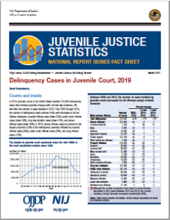
Delinquency Cases in Juvenile Court, 2019
NIJ FY22 Youth Mentoring Research and Evaluation
NIJ FY22 Research on Juvenile Justice Topics
NIJ FY22 National Juvenile Justice Data Analysis Program
Assessing the Role of Immigration in the Linkage between School Safety, Education, and Juvenile Justice Contact
Profile Analysis and Risk Assessment: Identifying Distinct Patterns of Risks and Needs
The Role of Cultural Factors on Dating Aggression and Delinquency Among Latino Youth
The development and validation of an algorithm to predict future depression onset in unselected youth
Annual Research Review: Youth firearm violence disparities in the United States and implications for prevention
Impact of a School-Based, Multi-Tiered Emotional and Behavioral Health Crisis Intervention on School Safety and Discipline
CrimeSolutions - The Evidence-based Guide for Justice Agencies in Search of Practices and Programs that Really Work
Desistance From Crime: Implications for Research, Policy, and Practice
Most scholars would agree that desistance from crime – the process of ceasing engagement in criminal activities – is normative. However, there is variability in the literature regarding the definition and measurement of desistance, the signals of desistance, the age at which desistance begins, and the underlying mechanisms that lead to desistance. Even with considerable advances in the theoretical understanding of desistance from crime, there remain critical gaps between research and the application of that research to practice.
See the YouTube Terms of Service and Google Privacy Policy