Juvenile delinquency prevention
Measuring School Climate: Validating the Education Department School Climate Survey in a Sample of Urban Middle and High School Students
Does Change in Perceptions of Peer Teen Dating Violence Predict Change in Teen Dating Violence Perpetration Over Time?
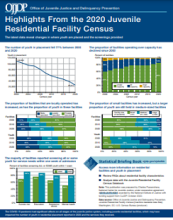
Highlights From the 2020 Juvenile Residential Facility Census
Exploring mentor practices using data from OJJDP’s Mentoring Enhancement Demonstration Program
National Juvenile Justice Data Analysis Program
The Benefits, Risks, and Challenges of Get-Tough and Support-Oriented Approaches to Improving School Safety
Children of the Incarcerated Must Be Studied, and Responded to, Comprehensively
AN EXEMPLARY PROJECT - JUVENILE DIVERSION THROUGH FAMILY COUNSELING: A PROGRAM FOR THE DIVERSION OF STATUS OFFENDERS IN SACRAMENTO COUNTY, CALIFORNIA
Fourth National Incidence Studies of Missing, Abducted, Runaway and Thrownaway Children (NISMART‐4) Law Enforcement Survey – Stereotypical Kidnapping (LES-SK) Technical Report
Extracurricular Activities, Screen Media Activity, and Sleep May Be Modifiable Factors Related to Children's Cognitive Functioning: Evidence From the ABCD Study(R)
Evaluation of an Intensive Truancy Reduction Program (ACT) Within Communities In Schools® (CIS)
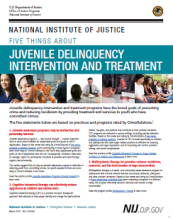
Five Things About Juvenile Delinquency Intervention and Treatment
Defining and Measuring Youth Digital Citizenship
Police Ambassadors: Student-Police Interactions in School and Legal Socialization
Implementing Youth Violence Reduction Strategies: Findings from a Scan of Youth Gun, Group, and Gang Violence Interventions
JDTC Evaluation Brief: Baseline and Service Data from Ten Sites Using Needs Based Assignment
Peers Influence Response to Threat: Cultural Norms, Reciprocity & Identity Processes in the Adolescent Caregiving System
Rethinking the Benefits of Youth Employment Programs: The Heterogeneous Effects of Summer Jobs
Traumatic brain injury and adverse psychological effects: Examining a potential pathway to aggressive offending
Juvenile Court Statistics, 2019
Mentoring Programs for Youth: A Promising Intervention for Delinquency Prevention
To realize the full potential of youth mentoring programs, it is critical to advance research on program effectiveness and population-level impact.
Mentoring Programs for Youth: A Promising Intervention for Delinquency Prevention
Advancing the Collection of Juvenile Justice Data
The National Institute of Justice and the Office of Juvenile Justice and Delinquency Prevention are working to improve data on juvenile residential placement facilities and the youth they hold.