


Multisite Adult Drug Court Evaluation Conceptual Framework
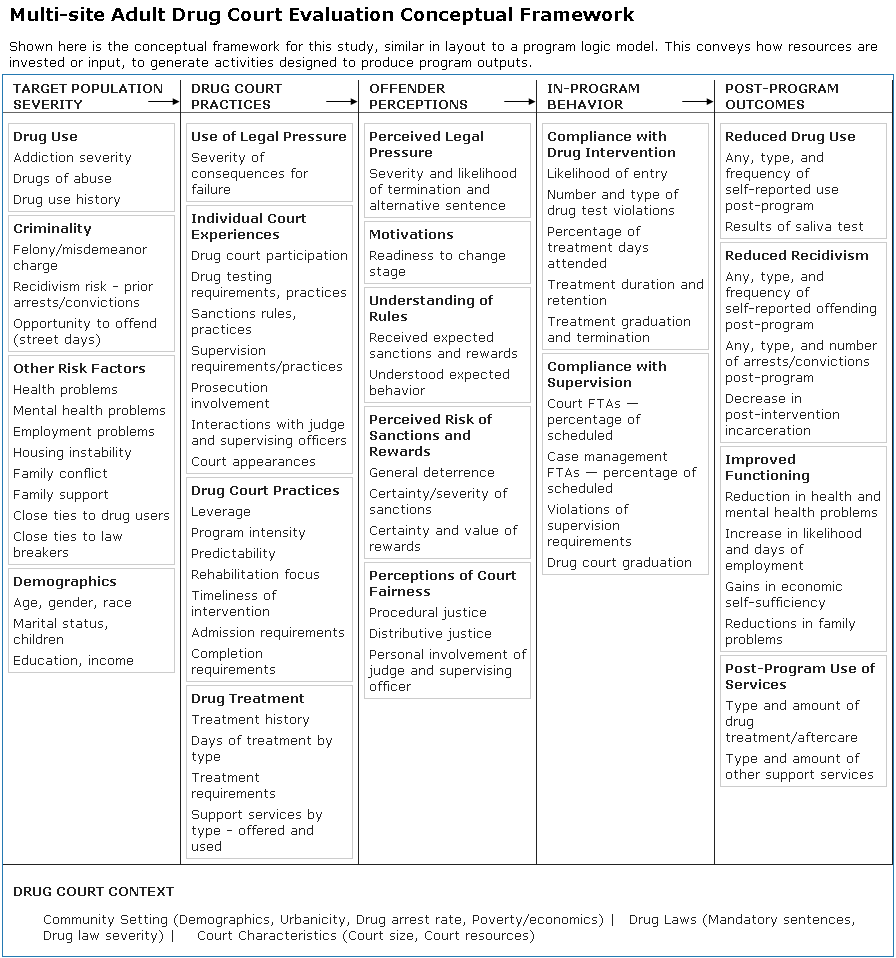
Description
The Multisite Adult Drug Court Evaluation (MADCE) Conceptual Framework has six components:
- Target Population Severity
- Drug Court Practices
- Offender Perceptions
- In-Program Behavior
- Post-Program Outcomes
- Drug Court Context
Conceptual Framework
- Target Population Severity
- Drug Use
- Addiction severity
- Drugs of abuse
- Drug use history
- Criminality
- Felony/misdemeanor charge
- Recidivism risk — prior arrests/convictions
- Opportunity to offend (street days)
- Other Risk Factors
- Health problems
- Mental health problems
- Employment problems
- Housing instability
- Family conflict
- Family support
- Close ties to drug users
- Close ties to lawbreakers
- Demographics
- Age, gender, race
- Marital status, children
- Education, income
- Drug Use
- Drug Court Practices
- Use of Legal Pressure
- Severity of consequences for failure
- Individual Court Experiences
- Drug court participation
- Drug testing requirements, practices
- Sanctions rules, practices
- Supervision requirements/practices
- Prosecution involvement
- Interactions with judge and supervising officers
- Court appearances
- Drug Court Practices
- Leverage
- Program intensity
- Predictability
- Rehabilitation focus
- Timeliness of intervention
- Admission requirements
- Completion requirements
- Drug Treatment
- Treatment history
- Days of treatment by type
- Treatment requirements
- Support services by type — offered and used
- Use of Legal Pressure
- Offender Perceptions
- Perceived Legal Pressure
- Severity and likelihood of termination and alternative sentence
- Motivations
- Readiness to change stage
- Understanding of Rules
- Received expected sanctions and rewards
- Understood expected behavior
- Perceived Risk of Sanctions and Rewards
- General deterrence
- Certainty/severity of sanctions
- Certainty and value of rewards
- Perceptions of Court Fairness
- Procedural justice
- Distributive justice
- Personal involvement of judge and supervising officer
- Perceived Legal Pressure
- In-Program Behavior
- Compliance With Drug Intervention
- Likelihood of entry
- Number and type of drug test violations
- Percentage of treatment days attended
- Treatment duration and retention
- Treatment graduation and termination
- Compliance with Supervision
- Court FTAs — percentage of scheduled
- Case management FTAs — percentage of scheduled
- Violations of supervision requirements
- Drug court graduation
- Compliance With Drug Intervention
- Post-Program Outcomes
- Reduced Drug Use
- Any, type, and frequency of self-reported use post-program
- Results of saliva test
- Reduced Recidivism
- Any, type, and frequency of self-reported offending post-program
- Any, type, and number of arrests/convictions post-program
- Decrease in post-intervention incarceration
- Improved Functioning
- Reduction in health and mental health problems
- Increase in likelihood and days of employment
- Gains in economic self-sufficiency
- Reductions in family problems
- Post-Program Use of Services
- Type and amount of drug treatment/aftercare
- Type and amount of other support services
- Reduced Drug Use
- Drug Court Context
- Community Setting
- Demographics
- Urbanicity
- Drug arrest rate
- Poverty/economics
- Drug Laws
- Mandatory sentences
- Drug law severity
- Court Characteristics
- Court size
- Court resources
- Community Setting